Architectural Material Mastery · Grade-A Teak

Specifying Engineering-Grade
Teak Patio Dining Furniture

The definitive B2B procurement framework and architectural design guide for luxury hospitality, resort dining decks, and high-end residential specifications worldwide.

23+ Years of Southeast Asian Craftsmanship & Precision Engineering

The Metallurgy & Organic Chemistry of High-Performance Teak Dining Systems

In the demanding realm of global commercial procurement, specifying Teak Patio Dining Furniture requires a rigorous understanding of raw material physics, micro-environmental resilience, and structural joinery. For over 23 years, Triconville has pioneered the vertical integration of Central Java teak craft with European engineering tolerances, supplying world-class resorts, urban rooftop venues, and luxury estates in more than 40 countries.

Unlike interior wooden furnishings or lower-tier exterior softwoods, true contract-grade outdoor teak dining tables and chairs must withstand brutal environmental stress: high UV exposure, rapid humidity fluctuations, coastal salt spray, and intensive daily commercial sanitization. By controlling our timber sourcing, kiln-drying operations, CNC machining, and finishing protocols in-house, Triconville delivers architectural outdoor dining systems engineered for decades of structural integrity and quiet aesthetic luxury.

100%Grade-A Heartwood Teak
8–12%Kiln-Dried Moisture Target
4Global Flagship Showrooms
SVLKCertified Legal Timber
Information Gain & Material Analysis

What B2B Procurement Officers & Architects Must Evaluate in Teak Patio Dining Furniture

A technical breakdown of timber chemistry, moisture stabilization, structural joinery, and long-term asset value.

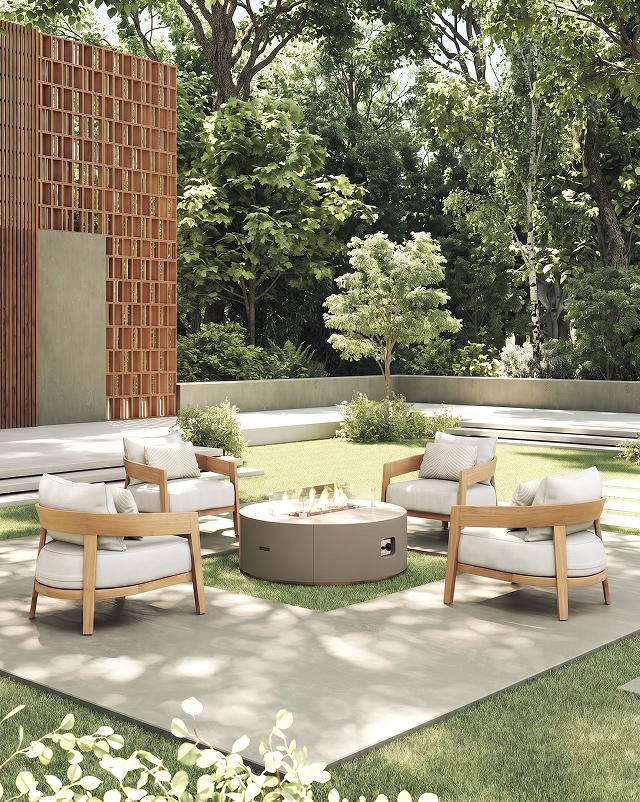
Triconville Grade-A Teak Patio Dining Furniture engineering craftsmanship
Material Science

1. Heartwood Oleoresin Content vs. Sapwood Vulnerability

The operational longevity of teak patio dining furniture rests entirely on the anatomical portion of the log harvested. True Grade-A Teak is exclusively extracted from the innermost heartwood of mature Tectona grandis trees (aged 30 to 50+ years). Heartwood is rich in natural oleoresins, tectoquinones, and natural silica granules.

These natural compounds act as an organic defense system, rendering the wood immune to fungal decay, subterranean termites, and water absorption. Sapwood (Grade-B and Grade-C), by contrast, lacks natural oils, possesses high starch content, and will split, warp, and rot within 18 to 24 months of outdoor commercial exposure.

2. 28-Day Computerized Kiln-Drying Protocol

Unstabilized teak retains a high equilibrium moisture content (EMC), leading to catastrophic joint separation, surface checking, and structural failure when exported to arid climates like Dubai or Riyadh. Triconville subjects all rough-sawn timber to a multi-stage 28-day computerized kiln drying chamber, reducing internal moisture to a strict 8%–12% threshold. This guarantees volumetric stability across seasonal temperature extremes.
Technical Specification Matrix: Teak Grading Criteria

Specification Feature Grade-A Teak (Triconville Standard) Grade-B Teak (Commercial Standard) Grade-C / Plantation Softwood
Harvest Log Region Mature Heartwood (30–50+ year trees) Outer Heartwood / Inner Sapwood transition Young Sapwood / Immature branches
Natural Oleoresin & Silica Maximum density; self-lubricating & waterproof Moderate; requires synthetic sealers Negligible; prone to rot and insect attack
Moisture Content (EMC) Controlled 8% – 12% via 28-day Kiln Drying 14% – 20% (Often air-dried, unstable) > 20% (High risk of severe warping)
Grain Profile & Color Tight, uniform straight grain; warm honey-gold Irregular grain; lighter yellow with dark knots Uneven white/grey tone; soft and porous
Commercial Lifecycle 25+ Years in extreme climates 3 to 7 Years before replacement 1 to 2 Seasons under commercial use
Environmental Compliance 100% SVLK / FSC Certified Perhutani Timber Variable origin compliance Often unverified supply chains
Architectural Dining Portfolio

Curated Teak Patio Dining Furniture Systems for High-Traffic Scopes

Engineered dining tables, stacking armchairs, and mixed-material seating modules built for contract durability and refined spatial aesthetics.

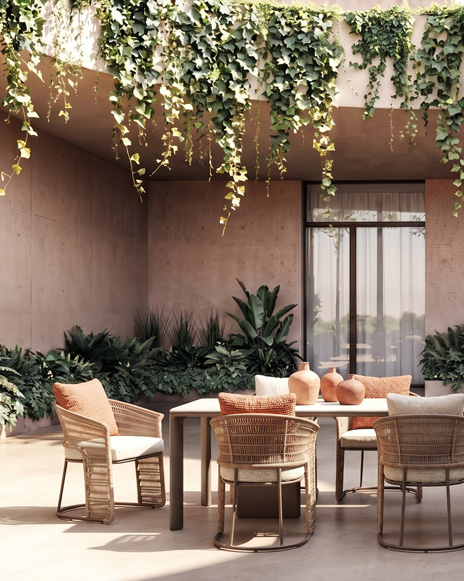
Minimalist Teak Patio Dining Table and Stackable Dining Armchairs
System 01 — Architectural Dining

The Apex Solid Teak Executive Dining Table

Featuring full-length Grade-A teak slats, bevelled structural perimeter framing, and concealed marine-grade 316 stainless steel tension rods. Engineered to seat 8 to 12 guests seamlessly in resort and villa settings.

Teak and Marine Grade Powder-Coated Aluminum Hybrid Dining Set
System 02 — Hybrid Materiality

The Element Teak & Aluminum Dining Series

Uniting warm kiln-dried teak table surfaces with architectural-grade powder-coated aluminum leg subframes (AkzoNobel coating). Lightweight yet ultra-stable, ideal for beachfront dining decks and rooftop terraces.

Tactile Teak and Solution-Dyed Outdoor Rope Dining Chair Collection
System 03 — Ergonomic Hospitality

The Studio Teak & Woven Rope Dining Armchair

Sculpted teak frames paired with weather-resistant solution-dyed polyolefin rope weaving. Integrated with reticulated quick-dry foam seating cushions covered in UV-resistant Sunbrella fabric.

Extendable Commercial Teak Patio Dining Table for Luxury Resorts
System 04 — Dynamic Capacity

The Synchronized Extendable Teak Dining Assembly

Designed with low-friction brass glides and an internal butterfly leaf storage mechanism. Enables smooth single-person expansion from 220cm to 320cm for flexible event capacity in luxury hospitality F&B environments.

Stackable Contract Teak Dining Chair for High Turnover Dining Areas
System 05 — Space Optimization

High-Density Stackable Teak Contract Chairs

Rigid mortise-and-tenon construction with concealed corner bracing, allowing up to 6 chairs to stack securely. Tailored for rapid banquet setup, seasonal storage, and high-footfall resort venues.

Strategic Market Insights

How evolving hospitality standards, circular economy mandates, and digital specification tools are reshaping outdoor dining procurement.

Trend 01 — Asset Lifecycle

Modular Repairability & Circular Asset Management

Commercial operators are moving away from disposable single-season outdoor furniture toward modular teak dining assemblies designed for component replacement. Triconville engineers all dining tables and chairs with standardized, replaceable slatted tops, leg mounts, and wear pads. If a single slat is damaged in a high-traffic restaurant setting, it can be unbolted and swapped without discarding the entire structural frame—drastically extending asset lifespan and lowering Total Cost of Ownership (TCO).

Trend 02 — Hybrid Materiality

Biophilic Tactility & Technical Metal Fusion

Contemporary landscape architecture increasingly demands tactile warmth paired with sleek structural profiles. We are seeing a surge in hybrid specifications combining Grade-A teak table surfaces with architectural-grade powder-coated aluminum, sintered stone inserts, and solution-dyed acrylic textiles. This hybrid language gives designers the natural luxury of timber at key touchpoints, backed by the lightweight structural efficiency of engineered metals.

Trend 03 — Digital Integration

BIM LOD 300+ & Digital Twin Specification

Modern hospitality architectural firms require production-ready Building Information Modeling (BIM) files early in the design phase. Triconville provides fully dimensioned BIM Revit models (LOD 300+), CAD blocks, and high-resolution PBR material textures for all teak dining collections. This allows specifiers to accurately calculate structural wind loads, spatial clearance dimensions, and sun-shadow interactions prior to procurement.

Trend 04 — Climate Resilience

Microclimate-Specific Finishes & UV Engineering

Global climate shifts mean outdoor furniture must endure extreme UV indexes in desert environments and relentless marine salt air in island resorts. Future product development prioritizes dual-finish options: untreated natural teak engineered to weather into a protective silver patina, or non-toxic hydrophobic water-based sealant systems that retain original golden-brown hues under intense solar radiation.

B2B Specification Portal

Accelerate Your Hospitality & Contract Procurement Project

Access technical cut sheets, material swatches, 3D/BIM CAD libraries, and direct factory pricing for bulk trade orders of Teak Patio Dining Furniture.

Manufacturing Excellence

Why Global Specifiers Partner with Triconville

Triconville stands as a vertically integrated manufacturer, controlling every phase of production from legal log procurement in Indonesia to high-precision CNC machining and final hand finishing. This end-to-end oversight ensures unparalleled quality control across multi-hundred-unit commercial dining orders.

  • 100% SVLK & FSC Certified Sourcing: Sourced exclusively from state-regulated Indonesian Perhutani teak plantations adhering to sustainable forest management practices.
  • Precision CNC Joinery: Computerized mortise-and-tenon milling eliminates mechanical play, preventing joint fatigue under intense commercial use.
  • Customization & OEM Capability: Full engineering flexibility to adapt table lengths, umbrella hole inserts, and custom frame finishes for boutique hotel or corporate restaurant specs.
  • Global Logistics Infrastructure: Distribution hubs and flagship showrooms in Dubai Design District, Jakarta, Kuala Lumpur, and Riyadh for seamless trade support.
Triconville Master Craftsmen Crafting Teak Patio Dining Furniture
Technical FAQ & Intent Mining

Frequently Asked Questions on Teak Patio Dining Furniture Procurement

Detailed technical answers to common queries raised by procurement managers, landscape architects, and interior designers.

Grade-A Indonesian teak is harvested strictly from the heartwood of mature trees (typically 30-50+ years old). It exhibits dense annual rings, a high concentration of natural oleoresin oils, and natural rubber content. This unique chemical profile renders it inherently impervious to water penetration, dry rot, termites, and severe thermal shock without requiring synthetic chemical pressure treatments. In contract dining settings, Grade-A teak maintains its dimensional stability and structural integrity far longer than Grade-B teak or softwoods like eucalyptus and acacia.

We subject all teak timber to a rigorous 28-day computerized kiln-drying regime, reducing equilibrium moisture content (EMC) precisely to 8-12%. Mechanically, we utilize precision CNC mortise-and-tenon joinery reinforced with marine-grade 316 stainless steel fasteners and waterproof polyurethane structural adhesives. This dual material and mechanical stabilization ensures that tables and chairs resist expansion, checking, or warping when exposed to extreme temperature variations (such as GCC desert heat or humid coastal marine environments).

While the initial capital expenditure for Grade-A teak is higher than powder-coated aluminum or softwoods, Grade-A teak dining sets offer a commercial service lifecycle exceeding 20-25 years under high turnover use. Alternative materials often require complete replacement every 3-5 years due to structural joint loosening, coating degradation, or internal corrosion. Over a 15-year horizon, Grade-A teak reduces replacement frequency by 300-400%, dramatically lowering lifetime asset management costs and disruption to operations.

Yes. Through our vertically integrated manufacturing facility in Central Java, Indonesia, we offer complete OEM/ODM specification flexibility. Contract specifiers can request custom table lengths (up to 400cm solid spans), custom leg profiles, integrated umbrella access ports with flush teak plugs, specialized wire-brushed or protective oil finishes, and custom upholstered seating cushions engineered with reticulated quick-dry foam and Sunbrella or Agora outdoor fabrics.

All timber processed by Triconville is 100% compliant with Indonesia's SVLK (Sistem Verifikasi Kelestarian Kayu) legal timber guarantee system, which satisfies strict EU Timber Regulation (EUTR), US Lacey Act, and Australian ILPA requirements. Our wood is harvested exclusively from legally certified, sustainably managed state-owned Perhutani plantations, ensuring zero contribution to illegal deforestation while supporting re-forestation initiatives.

Grade-A teak naturally weathers into a distinguished silver-grey patina over 6-12 months when left untreated outdoors, caused by surface oxidation under UV radiation. This patina forms a protective outer shield and does not compromise structural integrity. To maintain the original honey-gold tone, operators simply apply a breathable water-based teak protector annually. For general routine maintenance in restaurant settings, cleaning with mild soap, warm water, and a soft-bristle brush is sufficient to remove surface oils and dirt.