0%

For global buyers, choosing Teak Patio Dining Furniture involves more than selecting an attractive outdoor table. It requires attention to timber quality, construction, climate, maintenance, and supplier reliability. Teak is valued for its natural oils, tight grain, and resistance to moisture when properly managed. A well-made teak dining set can remain stable beside a humid pool, under strong sunlight, or on a covered terrace. It also develops a softer silver-gray surface over time. Some buyers prefer its original honey-brown color. Others welcome the aged appearance.

Practical inspection matters. Check whether tabletops use solid teak, examine joint strength, and ask how the wood was dried. Poorly seasoned timber may shrink or crack after shipment. That risk is easy to overlook. Confirm product dimensions, packaging methods, hardware materials, and replacement-part support before placing a large order. Suppliers should provide clear information about timber origin and relevant chain-of-custody documentation where applicable. Certifications can support responsible sourcing, but buyers should verify their scope and validity rather than relying on logos alone.

Teak patio furniture is not maintenance-free. It still needs regular cleaning, drainage, and sensible storage during severe weather. Coastal salt, freezing temperatures, and constant standing water can shorten its service life. This is where buyer experience becomes important. A reliable supplier explains limitations instead of promising perfection. That honesty builds trust. Comparing samples, factory photographs, inspection reports, and customer feedback can reveal details that a polished catalog hides. The best choice balances design, durability, responsible sourcing, shipping realities, and long-term value. Sometimes, the cheapest option becomes expensive later. That possibility deserves careful reflection.
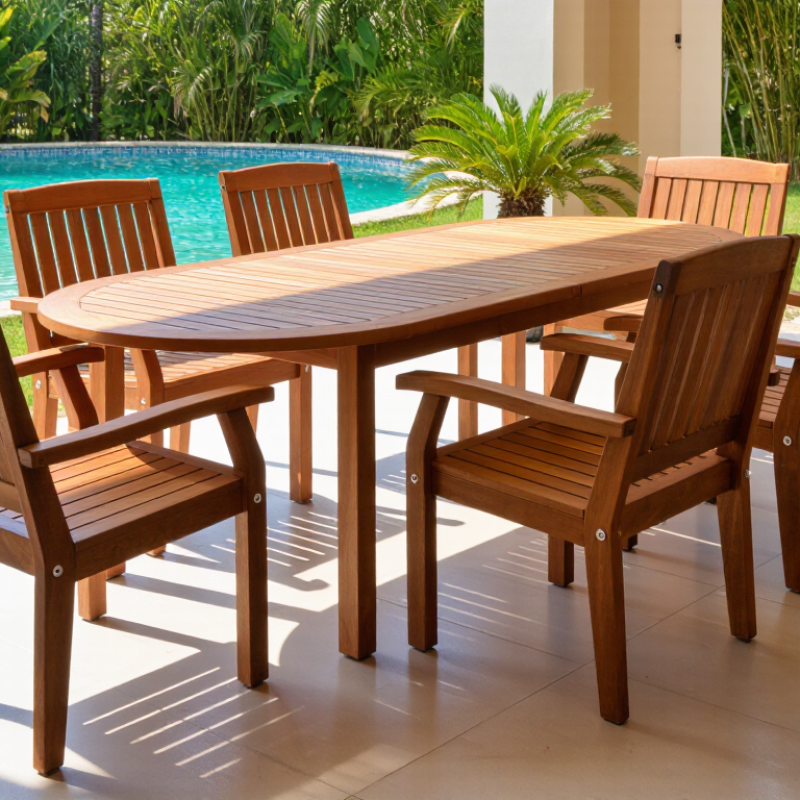
Why Choose Teak Patio Dining Furniture for Global Buyers?

What Is Teak Patio Dining Furniture?

Teak patio dining furniture means outdoor tables, chairs, benches, and serving pieces made from teak wood. Teak comes from Tectona grandis, a dense hardwood with natural oils. These oils help resist moisture, insects, and daily outdoor exposure. Its tight grain also supports stable performance during seasonal changes. The USDA Forest Products Laboratory’s Wood Handbook describes teak as a durable species with comparatively low shrinkage. That matters when a table faces sun, rain, and repeated cleaning.

Demand is expanding. Grand View Research estimated the global outdoor furniture market at more than USD 20 billion in 2022. Its report also projects steady growth through 2030. Teak patio dining furniture fits this trend because buyers want dining areas that feel permanent, not disposable. A well-made teak table can develop a silver-gray surface over time. That change is natural. Some owners prefer the original honey-brown color and apply suitable teak oil, although oiling is not always necessary.

Global buyers should inspect more than appearance. Ask for wood species, moisture control, joinery details, and documented supply-chain information. Responsible sourcing is important, especially where forest regulations differ. The FAO Global Forest Resources Assessment 2020 confirms that forests remain under pressure worldwide, so traceability deserves practical attention. Certified or legally documented teak can reduce sourcing risks, but certification alone does not guarantee excellent furniture. Check the wood’s finish, hardware, drainage design, and chair comfort. Teak is durable, not maintenance-free. That distinction is easy to miss.

Why Teak Is Suitable for Outdoor Dining Spaces

For global buyers, outdoor dining furniture must survive more than a sunny showroom. Teak suits patios because its dense grain, natural oils, and low moisture movement help resist rain, heat, and daily spills. The USDA Forest Products Laboratory’s Wood Handbook reports teak’s basic specific gravity at about 0.55, supporting its solid, stable feel without making it excessively heavy. That balance matters when tables are moved for events or stored seasonally.

Teak also performs well where diners sit close to food and furniture. Its surface can be sanded smooth, and its warm grain remains tactile after repeated cleaning. In practical projects, rounded edges and slatted tops often improve drainage around plates and glasses.

Yet teak is not maintenance-free. Unfinished boards gradually turn silver-gray, while neglected joints may collect dirt and moisture. That limitation deserves honest specification.

Responsible purchasing is equally important. FAO’s Global Forest Resources Assessment 2020 estimates that forests covered 31% of global land in 2020, after a net loss of about 420 million hectares since 1990. Buyers should request traceable plantation or legally verified sources, moisture-tested components, and clear care instructions. Certification can help, but paperwork alone cannot replace factory audits and sample inspections. A beautiful table can still be a poor choice if its origin remains unclear.

For global dining spaces, durability and responsible sourcing must be evaluated together.

Key Benefits for International Buyers

For international buyers, teak patio dining furniture offers a practical balance of durability, comfort, and visual appeal.

It is not maintenance-free. Teak’s natural oils help resist moisture, insects, and outdoor decay when construction is sound. This matters in coastal, humid, and seasonally wet markets. However, wood quality varies widely. Buyers should request species identification, kiln-drying records, moisture details, and lawful sourcing documents. A reliable supplier should also explain joinery, finish options, warranty terms, and care requirements clearly.

A well-made 180-centimeter table can seat six, while slatted chairs improve airflow after rain. Rounded edges feel safer around children and reduce damage during handling. Look closely at mortise-and-tenon joints, stainless-steel fasteners, and smooth underside finishing. These details reduce wobbling and rust staining in daily use.

For overseas orders, confirm folded dimensions, carton strength, assembly instructions, replacement parts, and container loading plans. A beautiful product can still become expensive if packaging is weak.

Fresh teak often appears honey-gold, then slowly develops a silver-gray patina under sunlight. This change is natural, not a defect. Some buyers prefer the original tone and need periodic cleaning with suitable products. Others accept the weathered surface. Care decisions should match the local climate and the owner’s routine.

In freezing regions, furniture should dry completely before sheltered storage. One honest limitation matters: dense teak is heavy, so moving a six-seat set may require two people. That inconvenience is easy to overlook.

Sourcing, Quality, and Sustainability Considerations

Why Choose Teak Patio Dining Furniture for Global Buyers?

Sourcing, Quality, and Sustainability Considerations

Global buyers often choose teak for outdoor dining because its dense grain handles sun, rain, and daily use. In practical sourcing, the wood’s origin matters as much as its appearance. Ask suppliers for harvest records, species details, and traceable supply documents. Independent inspections can verify these claims before shipment. A small sample may reveal uneven color, open joints, or excessive moisture.

Quality begins with properly seasoned timber. For outdoor furniture, stable moisture levels help reduce cracking and movement. Check table thickness, joint construction, drainage design, and corrosion-resistant hardware. Sit on the chairs and test their balance. Factory photographs are useful, but they cannot replace physical inspection. I have seen attractive samples fail when packaging allowed water inside cartons.

Sustainability requires more than a green label. Buyers should examine legal harvesting records, responsible forest management, and the supplier’s waste practices. Plantation-grown or reclaimed teak may support better resource planning, but each claim needs evidence. Ask how offcuts are reused and whether finishes contain restricted substances for the destination market. Documentation can be incomplete, especially across long supply chains. That weakness deserves attention, not polite assumptions. A slightly imperfect surface may be acceptable; hidden moisture or unclear sourcing is harder to justify.

Why Choose Teak Patio Dining Furniture for Global Buyers? - Sourcing, Quality, and Sustainability Considerations

Evaluation Dimension Indicative Data or Benchmark Relevance to Global Buyers Recommended Verification
Wood species Genuine teak is botanically identified as Tectona grandis. Correct species identification helps prevent substitution with visually similar hardwoods. Request the botanical name, country of harvest, and species declaration on commercial documents.
Natural outdoor durability Teak is commonly classified as highly durable because its extractives and natural oils help resist moisture, fungi, and insects. Suitable for patios, terraces, gardens, and coastal environments when furniture is properly designed and maintained. Check test data, joinery details, drainage design, and the supplier’s care instructions rather than relying only on marketing claims.
Dimensional stability Typical published shrinkage values for teak are approximately 2.6% radial and 5.3% tangential from green to oven-dry condition. Lower movement can reduce cracking, warping, and loose joints compared with many less stable woods. Ask for moisture-content records and inspect panel construction, end sealing, and allowance for seasonal movement.
Density and strength Published oven-dry specific-gravity values for teak are commonly around 0.55–0.65, depending on source and test method; reported Janka hardness is about 1,070 lbf. Provides a useful balance of structural performance, impact resistance, and manageable furniture weight. Compare material specifications, load tests, fastener quality, and the intended use of each dining chair and table.
Moisture content at production A practical target for outdoor furniture is often approximately 12–18%, adjusted for the destination climate and construction method. Furniture shipped too wet or too dry may experience movement after arrival in a different climate. Require batch moisture readings, measurement locations, and a documented acceptance range before shipment.
Timber legality Legally sourced timber should have traceable harvest, transport, processing, and export documentation. Reduces customs, reputational, and supply-chain risks in international trade. Collect permits, invoices, transport records, customs documents, and supplier due-diligence files.
Responsible forestry certification Forest-management certification and chain-of-custody certification are separate controls; both should cover the relevant product and supply chain. Supports claims about responsible sourcing while improving traceability from forest to finished furniture. Verify certificate validity, product scope, certificate holder, and transaction or claim documentation.
Plantation versus natural-forest origin Plantation-grown teak and naturally regenerated or natural-forest teak can differ in growth rate, density, grain, and legal requirements. Origin affects sustainability assessment, product consistency, price, and market-access documentation. Request origin declarations, plantation or forest-management records, and independent chain-of-custody evidence.
Hardware and corrosion resistance Stainless-steel hardware, commonly grades 304 or 316, is preferred for outdoor furniture; grade 316 generally offers better chloride resistance than grade 304. Appropriate hardware reduces staining, rusting, and joint failure, especially near saltwater. Confirm hardware grade, fastener size, weld quality, and compatibility between metal components and teak extractives.
Surface treatment Untreated teak naturally weathers from golden brown to silver-gray; oil or sealant can change appearance but requires periodic maintenance. Buyers can select between lower-maintenance weathering and a maintained original color. Review coating composition, UV performance, reapplication intervals, and cleaning restrictions.
Furniture safety and performance Outdoor seating and tables should be assessed against applicable market requirements, such as EN 581 where relevant, including stability, strength, and durability tests. Documented testing supports safer commercial, hospitality, and residential applications. Request current laboratory reports, test methods, sample descriptions, and product-model references.
Packaging efficiency Flat-pack or stackable designs can increase container utilization and reduce packaging volume, but must not compromise structural integrity. Improves landed-cost control and may lower transport emissions per dining set. Compare cubic-meter utilization, stack height, packaging weight, damage rates, and recycled-content percentage.
End-of-life potential Solid untreated wood can generally be repaired, reused, refurbished, or mechanically recycled more easily than composite materials. Longer service life and repairability can reduce replacement demand and waste. Check whether parts are replaceable, finishes are removable, and materials can be separated at disposal.
Total cost of ownership Evaluate purchase price together with freight, duties, assembly, maintenance, repair, replacement parts, and expected service conditions. A higher initial cost may be justified when durability, repairability, and lower replacement frequency are demonstrated. Build a landed-cost model and compare warranty terms, spare-part availability, and maintenance requirements.
Data note: Indicative timber-property values are compiled from commonly cited wood-property references and may vary by origin, growth conditions, moisture content, grading, and test method. Certification, legality, and regulatory requirements should be verified for the specific destination market and shipment.

How to Choose Teak Patio Dining Furniture for Different Markets

Why Choose Teak Patio Dining Furniture for Global Buyers?

Teak patio dining furniture suits many climates because its dense wood handles moisture, sunlight, and daily outdoor use. However, market requirements differ sharply. Buyers in rainy regions may prioritize drainage and mildew-resistant cushions. In dry, hot areas, UV protection and stable joinery become more important. I have seen outdoor sets perform well in one market but disappoint in another. Local weather always changes the decision.

Choose furniture dimensions that match regional dining habits and available spaces. Compact balconies need slim tables and stackable chairs. Larger hospitality projects may require modular layouts and replaceable parts. Check wood sourcing documents, moisture levels, surface treatments, and packaging quality. These details support reliable importing and responsible purchasing. They also reduce avoidable claims. Do not judge quality from photographs alone. I once underestimated shipping humidity, and several cartons arrived with minor surface changes. Better ventilation and moisture checks would have helped.

Tips: Compare climate data, customer habits, and local regulations before ordering. Request samples and test chair stability on uneven flooring. Confirm table clearance, cushion fabric performance, and spare-part availability. Leave room for honest feedback. A perfect finish may not suit every market, and natural teak can show color variation. Explain that clearly to customers before delivery.

FAQS

Why is teak suitable for outdoor dining spaces?

Dense grain and natural oils help teak resist rain, heat, spills, and daily outdoor use. It feels solid. However, it is not maintenance-free.

How many people can a typical teak dining table seat?

A 180-centimeter table can usually seat six people comfortably. Allow enough clearance for chairs and walking paths. Small balconies need narrower designs.

What furniture details improve outdoor performance?

Slatted tabletops help rain drain around plates and glasses. Rounded edges feel safer near children and reduce handling damage. Strong joints matter more than decoration.

What construction features should international buyers inspect?

Check mortise-and-tenon joints, stainless-steel fasteners, and smooth underside finishing. Ask for moisture details and kiln-drying records. Photographs are not enough.

Does teak require regular maintenance?

Unfinished teak slowly changes from honey-gold to silver-gray under sunlight. This natural patina is not a defect. Still, neglected joints can hold dirt and moisture.

How should buyers choose teak furniture for different climates?

Rainy regions benefit from good drainage and mildew-resistant cushion materials. Hot, dry regions need stable joinery and suitable UV protection. Local weather changes everything.

What should buyers verify before placing an overseas order?

Request wood species identification, traceable sourcing documents, moisture information, and care instructions. Confirm carton strength, folded dimensions, assembly guidance, and replacement parts. Weak packaging becomes expensive.

Is teak furniture easy to move and store?

Dense teak is relatively heavy, so two people may need to move a six-seat set. Furniture should dry fully before sheltered storage in freezing regions. I would not underestimate this inconvenience.

Conclusion

Teak Patio Dining Furniture is designed for outdoor meals, gatherings, and hospitality settings where durability, comfort, and visual appeal are essential. Teak is naturally dense and rich in protective oils, helping it withstand moisture, sunlight, temperature changes, and frequent use better than many common wood types. Its warm color and timeless appearance also allow it to complement a wide range of outdoor design styles, from residential terraces to restaurants and resorts.

For international buyers, selecting the right teak furniture requires attention to wood quality, construction, finish, packaging, and supply consistency. Buyers should evaluate whether the teak is responsibly sourced, properly seasoned, and manufactured with reliable joinery and weather-resistant hardware. Market preferences may differ in table size, chair comfort, color, maintenance expectations, and price range, so product selection should reflect local climate, customer habits, and commercial requirements. With careful sourcing and market-focused planning, teak dining furniture can provide long-term value, dependable performance, and a sustainable outdoor furnishing solution.

Oliver

Oliver

Oliver is a dedicated marketing professional with a deep understanding of the company’s products, customers, and industry landscape. With a strong background in market research, content strategy, and digital communication, he specializes in translating complex product features into clear,......