Outdoor entertaining has become more than a passing design trend. Grand View Research valued the global outdoor furniture market at approximately $50.73 billion in 2023 and projected continued growth through 2030. That figure covers a broad category, not bar stools alone, but it signals how much attention buyers give to outdoor spaces. Comfort matters. So does durability.
Choosing High-End Outdoor Bar Stools takes more than matching a frame to a patio table. A seat that looks elegant in a showroom may feel cramped after dinner or wobble on uneven stone. Check the seat height against your counter, then consider how the stool handles rain, sun, and salty air. Aluminum, teak, and outdoor-grade woven materials each age differently. No finish is maintenance-free. That is easy to forget.
The tips ahead focus on practical details: stable footrests, supportive backs, weather-resistant construction, and cushions that dry without trapping moisture. Look closely at welds, joints, hardware, and warranty terms. A premium price should come with clear specifications, not just polished product photos. Even then, there is a trade-off. The lightest stool is easier to move, but it may feel less secure in strong wind. A careful choice balances comfort, upkeep, and the conditions of your own outdoor space.
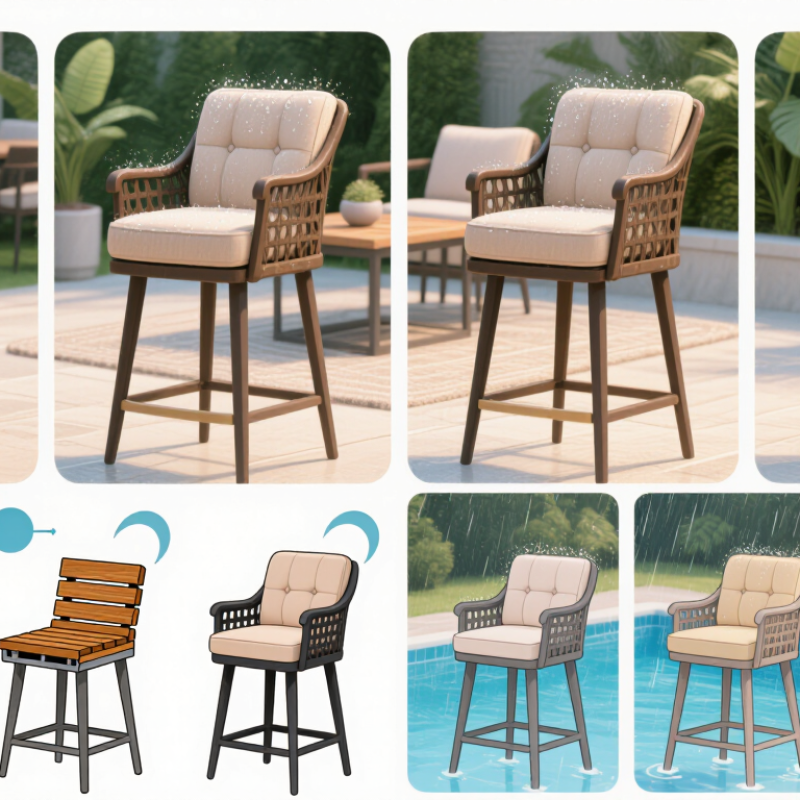
A comfortable stool starts with a tape measure, not a guess. Measure from the floor to the counter surface, then choose a seat that sits 10–12 inches below it. For a 36-inch counter, that often means a seat around 24–26 inches high. Check the actual counter; stone thickness and built-in trim can change the fit.
Measure twice. The gap should let guests sit without knocking their knees, while keeping drinks and plates within easy reach. If the counter has a deep apron, measure from its underside too. A stool may match the height on paper and still feel cramped. That detail is easy to miss.
Outdoor cushions can add height when compressed less than expected, so check the finished seat height with the cushion in place. Leave room to slide stools under the counter, and consider whether arms will clear its edge. On a patio, uneven paving can also affect how a stool feels. It is a small tolerance, but not a trivial one. For a shared space, test one stool before ordering a full set.
When choosing high-end outdoor bar stools, measure the dining surface before comparing seat heights. Under ADA standards, applicable dining surfaces must measure 28 to 34 inches from the finished ground to the top. Measure twice. A surface near the upper limit may feel awkward with a low seat, while a tall stool can leave little room for knees.
Check more than the number. Accessible seating needs a clear approach, and the area beneath the surface must allow appropriate knee and toe clearance. A stable, level path matters outdoors, where pavers can shift and chair legs may wobble. Leave enough room for a person using a mobility device to reach and use the seating space. Exact requirements depend on the setting, so verify the standards that apply to your project.
A common design trap is treating one accessible table as a box to check. Its location and usability matter; placing it far from the main dining area can make it feel like an afterthought. Smooth edges, weather-resistant materials, and footrests improve comfort, but they do not replace proper clearances. This detail is easy to miss when a patio looks finished.
The 2010 ADA Standards specify a height of 28–34 inches for accessible dining and work surfaces. This measurement applies to the surface, not the bar stool seat; check the finished surface and seating dimensions separately when planning an outdoor dining area.
When comparing finishes for high-end outdoor bar stools, treat ASTM B117 hours as a screening measure, not a promise of years outdoors. The test exposes coated samples to a controlled salt fog, often continuously, and records corrosion or coating damage. Ask whether the report names the substrate, surface preparation, coating thickness, and failure criteria. Without those details, two figures may not be comparable. A 1,000-hour result means little if one sample was tested with a scratched coating and the other was not. Details matter.
Look for results that describe rust, blistering, and corrosion spreading from a scribed line. Then consider the stool’s actual setting: coastal air, poolside splashes, and damp feet on a lower frame can stress different areas. Powder-coated aluminum and coated steel may respond differently, even at similar test durations. Do not assume more hours always means better furniture; the test does not reproduce UV exposure, cleaning, or years of handling. A tidy comparison chart can be persuasive, but I would still request the test method and report. That extra step is worth it.
When evaluating high-end outdoor bar stools, ask for UV exposure data, not a vague “weather-resistant” claim. ASTM G154 provides a controlled method for exposing nonmetallic materials to fluorescent UV light and moisture. One commonly used cycle runs eight hours of UVA-340 exposure at 60°C, followed by four hours of condensation at 50°C. These conditions help buyers compare test reports, but they do not prove a stool will last a fixed number of years outdoors.
Look closely at what was tested. A report for a resin sample may not represent the finished seat, coating, or woven surface. Ask whether the tested material matches the stool’s actual color and formulation, and check for changes in color, cracking, chalking, or loss of strength. Small details matter. Inspect joints and undersides too; sunlight reaches more than the top surface.
ASTM G154 is a test practice, not a universal pass-or-fail rating. Its exposure hours cannot be converted reliably into outdoor service years without relevant field data. That part is easy to overlook. Request the lamp type, cycle, total exposure time, and documented evaluation method. A clear report is more useful than an impressive hour count, though I would still want to see how the sample was mounted and assessed.
Source: ASTM G154, Standard Practice for Operating Fluorescent Ultraviolet (UV) Lamp Apparatus for Exposure of Nonmetallic Materials.
A high-end outdoor bar stool should survive more than a quick showroom sit. Ask for a test report that identifies the exact stool model and test method. ANSI/BIFMA X5.4-2020 covers public and lounge seating, including seat and back durability, strength, and stability evaluations. Check that the lab assessed the stool under a suitable seating category; a bar-height design may not map neatly to every test setup. Numbers matter. Look for recorded loads, cycle counts, sample quantity, and pass/fail results—not just a vague “tested” claim.
Outdoor exposure needs separate evidence. ASTM G154 describes controlled ultraviolet-light and moisture exposure, but test hours do not directly equal years outdoors. Ask whether the report names the exposure cycle and documents changes such as fading, cracking, or coating failure. For metal frames, inspect joints and welds; for woven seats, check whether fibers loosen after repeated loading. A glossy finish can hide weak details. That’s not enough. I would also review the test date and sample configuration, since small design changes can affect performance. Standards help compare evidence, but they do not guarantee a stool will suit every climate or care routine.
| # | Selection tip | What to verify | Relevant standard or test method | Practical buying check |
|---|---|---|---|---|
| 1 | Request a test report for the exact stool | Confirm the report identifies the same model, construction, and configuration you plan to buy. A standard’s name alone does not prove that a product passed testing. | ANSI/BIFMA X5.4, Public and Lounge Seating, where applicable to the product and test scope. | Ask for the report date, tested configuration, results, and laboratory identity; check whether any options or materials differ from the offered stool. |
| 2 | Confirm the standard fits the seating category | Public and lounge seating tests may be relevant to stools, but applicability depends on the product design and the standard’s scope. Do not assume an office-chair test automatically qualifies a bar stool. | ANSI/BIFMA X5.4; ANSI/BIFMA X5.1 is for general-purpose office chairs and should not be treated as a universal bar-stool standard. | Have the supplier or testing laboratory state which standard and edition were applied and why they apply to this seating type. |
| 3 | Review structural and durability test coverage | Check which applicable strength, stability, and repeated-use evaluations were performed, and whether any failures, repairs, or exclusions are recorded. | ANSI/BIFMA X5.4 test procedures, when applicable; use the report to identify the specific tests performed rather than relying on a general claim. | Look for test outcomes and notes on loosened joints, deformation, tipping, or damage. Do not infer an unreported load rating from a pass statement. |
| 4 | Assess outdoor corrosion resistance separately | Inspect the specified alloy or steel grade, protective coating, fasteners, welds, and care instructions. Outdoor seating durability is not established by a seating-strength test alone. | ASTM B117 is a salt-spray test method; it does not by itself set a universal product pass/fail threshold or guarantee service life. | Request the exposure duration, evaluation criteria, and results, and ask whether the tested finish and hardware match the production specification. |
| 5 | Check UV and weathering claims | Ask how exposed plastics, coatings, webbing, and upholstery were evaluated for fading, cracking, or loss of strength. Results depend on material, exposure conditions, and evaluation method. | ASTM G154 provides a practice for operating fluorescent UV-lamp apparatus for exposure of nonmetallic materials; it is not a direct prediction of outdoor service life. | Request the test conditions, duration, material tested, and before-and-after evaluation criteria. Match the tested material to the stool’s actual finish or fabric. |
| 6 | Match seat height to the counter or bar | Measure from the floor to the underside of the counter or bar, then compare with the stool’s seat height and any adjustment range. Common seat-height ranges are guidance, not a universal standard. | No ANSI/BIFMA standard sets one seat height for all counters or bars. | As a general planning guide, counter stools are often around 24–27 in. high and bar stools around 28–32 in.; verify comfort and clearance at the actual installation. |
| 7 | Inspect joints, welds, and fasteners | Look for consistent welds, secure joints, accessible replacement fasteners, and construction that does not trap water unnecessarily. | Relevant construction and performance checks may be included in the applicable ANSI/BIFMA X5.4 evaluation; confirm the report’s scope. | Ask whether fasteners are corrosion-resistant and whether the manufacturer provides tightening or maintenance guidance. |
| 8 | Evaluate the footrest and contact points | Check footrest attachment, edge comfort, finish durability, and whether the design supports a stable seated posture for the intended users. | Use the applicable seating test report for structural evaluation; there is no single universal footrest dimension for every bar stool. | Inspect a sample in person when possible and confirm that the footrest is included in the tested configuration. |
| 9 | Consider the installation surface and stability | Check the base footprint, floor-contact points, and suitability for the intended surface. Uneven paving or a sloped deck can affect stability regardless of test results. | Review applicable stability evaluations in the ANSI/BIFMA test report; test results apply to the tested setup and conditions. | Confirm the stool sits level on the planned surface and ask whether adjustable glides or other leveling features are available. |
| 10 | Compare warranty, maintenance, and replacement support | Review warranty exclusions for outdoor exposure, coastal locations, finishes, fabrics, and commercial use. Confirm the recommended cleaning and inspection routine. | A warranty is not a substitute for ANSI/BIFMA testing or weathering evidence; standards do not define an individual seller’s warranty coverage. | Ask about replacement parts, finish care, and written coverage terms, especially for high-use or salt-air environments. |
Note: Standards and test methods have defined scopes. Confirm the current edition, applicability, test configuration, and acceptance criteria with the supplier or an independent testing laboratory. Test results do not guarantee a particular outdoor service life.
It compares coated samples exposed to controlled salt fog. It does not promise a specific outdoor lifespan. Details matter.
Check the substrate, surface preparation, coating thickness, test duration, and failure criteria. Ask whether samples had scratches or scribed lines.
Not necessarily. Different samples and test conditions can make hour counts hard to compare. A chart may hide those differences.
Request the lamp type, exposure cycle, total hours, and evaluation method. Confirm the tested material matches the stool’s actual finish or seat.
No reliable conversion. The test helps compare materials, but it does not fully recreate sunlight, cleaning, or handling.
Check for fading, cracking, chalking, or reduced strength. Inspect undersides and joints too; they can be easy to overlook.
Ask for a report naming the exact stool model and suitable test method. ANSI/BIFMA X5.4-2020 covers public and lounge seating, but bar-height designs may not fit every setup.
Check frame joints and welds, plus woven fibers after repeated loading. Consider coastal air, pool splashes, and damp feet on lower rails. I would still inspect it myself.
Choosing High-End Outdoor Bar Stools starts with matching the seating to its intended setting and counter height. As a practical guide, aim for a seat that is 10–12 inches below the counter to allow comfortable legroom. Also consider accessibility: ADA dining surfaces generally measure 28–34 inches high, so check the table or counter dimensions and provide suitable seating clearance.
For outdoor use, look beyond appearance and compare durability evidence. Ask how frame finishes performed in ASTM B117 salt-spray testing, noting the test duration and conditions rather than relying on a finish label alone. Assess fabric and other exposed materials using ASTM G154 UV exposure results, and review how they may respond to prolonged sunlight. Finally, verify that the stools have been evaluated against applicable ANSI/BIFMA test standards for seating durability. Considering fit, access, weather resistance, and testing together can help you choose stools that are comfortable and suited to their environment.